The objective of the monitoring of open science and research is
- to support the development of open science and research in organisations,
- support and verify the achievement of the objectives agreed in the Declaration and policies, and
- form an overall view of the state of openness in Finnish science and research.
Monitoring will use as much available, comparable data collected in the National Research Information Hub as possible. Monitoring also involves collecting data using a survey. The role of the survey as a source of monitoring data will decrease as more data accumulate in the National Research Information Hub. Initially, the survey plays a key role.
Key documents:
- Monitoring model for open science and research
- Indicators used in the monitoring of open science and research and their scoring (spreadsheet)
- Assessment of the Total Costs of Open Scholarly Publishing in Finland
Development of the monitoring model in 2026
In October 2025, the National Steering Group for Open Science and Research established a strategic-level working group to develop the monitoring model. The working group consists of six members and deputy members of the Steering Group, representing different sectors of research.
To support the work, an expert group has been formed from representatives of organisations that responded to the monitoring survey in 2024. The expert group includes eight members from different types of research organisations. The groups work in close collaboration with each other and with the Steering Group.
The objective is to update the principles of monitoring during the spring to guide future monitoring rounds. A possible national consultation on the monitoring principles will be organised in autumn 2026.
To support the development work, the Open Science and Research Secretariat conducted a survey among organisations that responded to monitoring in 2024. A total of 31 responses were received.
-
Anonymised responses to the survey (in Finnish, link)
Monitoring schedule
The monitoring was carried out for the first time in 2022. In 2022, the monitoring was light and largely based on existing and well-known indicators and the needs of European monitoring. Monitoring carried out in 2024 was broader. The decision on arranging monitoring in 2026 and the indicators to be used was made by the National Open Science and Research Steering Group in December 2024. The decision was complemented in the May 2025 meeting.
The monitoring 2026 survey will be open from 4 May to 15 June 2026.
The results of the monitoring were published on the research.fi website in October 2026, and the results of the survey in data will be made openly available after the results have been published. The calculation logic for the results of the organisation types presented on the Research.fi website is described in this document (Google Docs).
Indicators and scoring
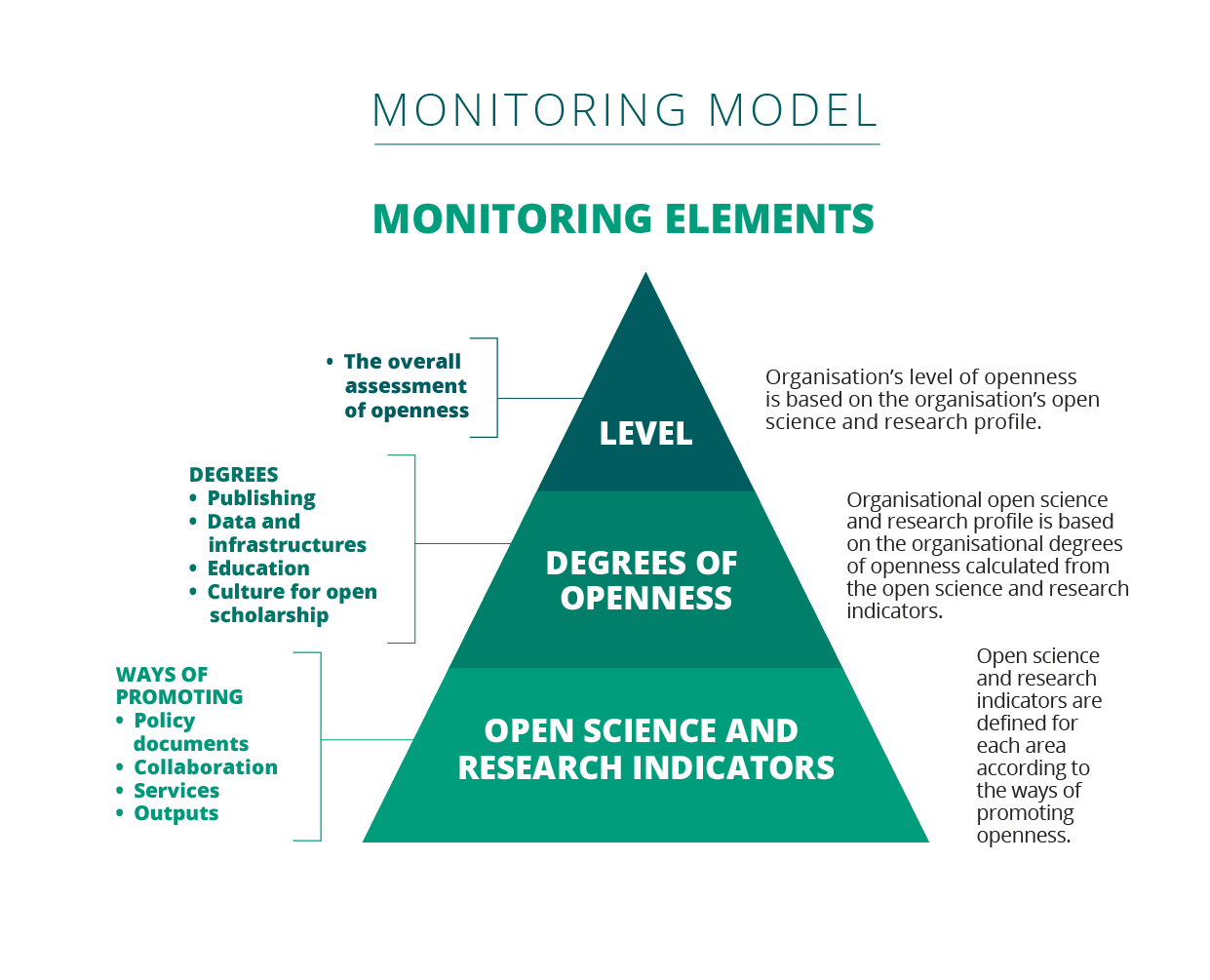
The indicators used in the monitoring will be used as the basis for determining organisations’ openness profiles and their level of open science and research. Limited indicators were used in 2022. In 2024 monitoring, the indicators were complemented to cover all areas. The principles of scoring are transparent and accessible to all.
Each indicator is scored. The points are either “base points” or “additional points”. The base points apply to practices that are central to the implementation of policies for all organisations. The additional points apply to practices that are still new, under development or create added value. The scoring principle is that you get the same score for the same type of questions. In addition, questions that require more work from the organisation give higher scores.
The scores are used to determine the degree of openness in the organisation for each area. The degree of openness (1–5) in a given area is determined for each organisation based on the percentage given to them of the maximum number of the base points on one hand and of the maximum number of the total points on the other. The percentage-based model makes it possible to add new indicators to monitoring in the future and it can be scaled according to the development of open science and research.
Together, the degrees of openness in the various areas comprise an openness profile for the organisations. The profile makes an organisation’s degree of openness visible in different areas (publications, materials and infrastructure, learning and operating culture), and, if necessary, the degree of openness can also be studied from the perspective of operating methods (policy documents, services, cooperation and output).
The profile is also used as the basis for an overall assessment of openness in the organisation. In addition to the baseline, there are five levels in the overall assessment. The levels are defined in such a way that climbing to the next level requires either a one-step increase in two areas or a two-step increase in one area (i.e. the average score for the areas increases by half a step). Climbing to the higher overall assessment levels also requires increasing the degrees given to all profile areas to some extent.
Background
In 2020, the National Open Science and Research Steering Group appointed a working group to develop a next-generation model for monitoring open science and research in Finland. In addition to the working group, the expert members of Open Science and Research Coordination in Finland participated in the development of the monitoring model through cocreation carried out in May 2020, and the model was out for an open round of comments at the national level between 27 September and 1 November 2021. 54 organisations commented on the monitoring model.


