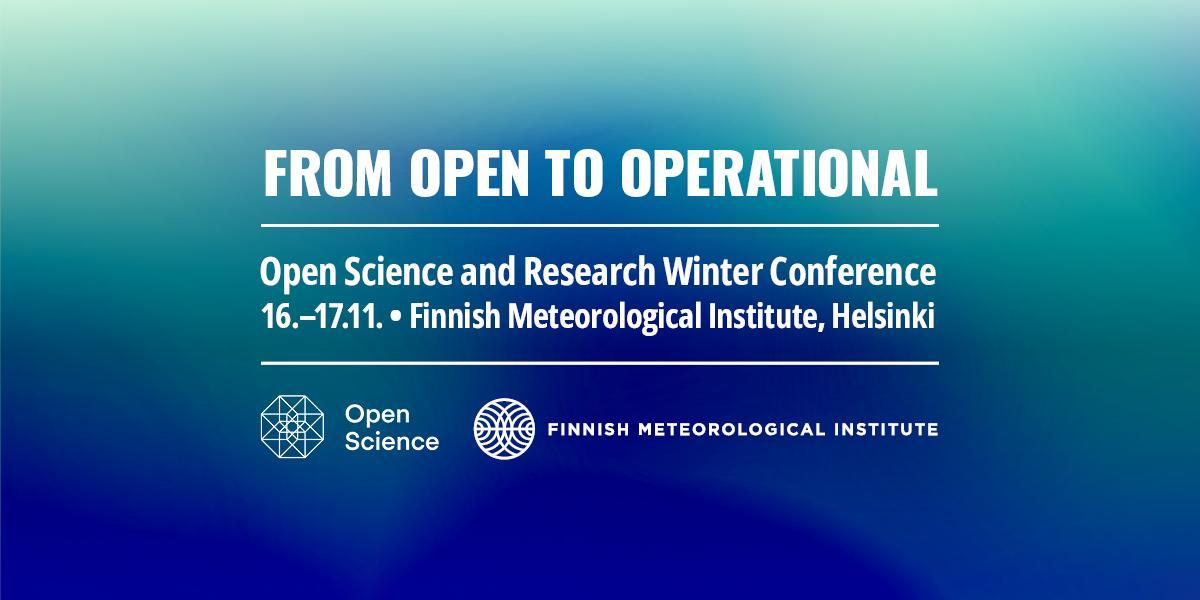
The Open Science and Research Winter Conference brings together researchers and experts of open science at Helsinki. Remote participation is also possible.
This year’s Winter Conference will shift the focus from the principles of open science to their practical implementation. The central question is therefore not whether science should be open, but rather how openness can become an integral part of everyday research practices and how it can generate scientific and societal impact. This news article highlights a selection of sessions from the diverse programme.
Keynote on the current state of open science by the developer of eduroam
The keynote speech on the first day, “Open Science in a Fragmented AI-driven World” will be delivered by Klaas Wierenga, Chief Services Officer at GÉANT. Wierenga has a long history in innovation management and is the developer of eduroam, the wireless network roaming service. This international, secure and free service is used by educational institutions, universities and research institutions on every continent and in more than 100 countries, including Finland.
Wierenga’s keynote will open the Winter Conference on Monday 16 November, at 10:30, following the welcoming remarks.
What do researchers actually need?
Everyday practices and the practical implementation of openness in science and research will take centre stage at the event. In the session “What Researchers Actually Need? Looking for the Bottlenecks”, researchers from different disciplines will discuss the factors that slow down research and explore how open science could best support their work. The topic highlights a practical challenge of open science: principles and policies alone do not guarantee that openness can be easily integrated into researchers’ everyday work.
The closing session on the second day, “Building an Infrastructure That Researchers Will Actually Use”, will bring together key insights from the Winter Conference and explore what kinds of research infrastructures researchers would genuinely want to use.
The first day’s discussion on bottlenecks will feature Harri Kokkola and Maxime Grandin from the Finnish Meteorological Institute, Veikko Ikonen from VTT Technical Research Centre, and researcher of communication and technology Salla-Maaria Laaksonen from the University of Helsinki.
In the second day’s infrastructure session, the audience will have an opportunity to contribute alongside Jessica Parland-von Essen from CSC and EOSC, Emma Bruus from Ursa Astronomical Association, Tomi Rosti from the University of Eastern Finland, and Marko Peura from the Research Council of Finland.
AI needs to be supported by a robust research infrastructure
The session “AI Will Not Save a Bad Research Infrastructure” will examine the relationship between artificial intelligence and research from the perspectives of practical implementation and open science. The effectiveness of AI systems depends, among other things, on the data, metadata and knowledge structures underpinning them.
Is it even possible to use AI responsibly and ethically in research? How are open science and AI connected in research? The discussion will explore the foundations needed for trustworthy and reproducible AI-assisted research.
The speakers will be Anna Lindfors from CSC, Reija Haapanen from Responsible AI association, Ossi Nokelainen from the University of Jyväskylä and Anu Helkkula from Hanken School of Economics.
News from the National Open Science Coordination and a remote morning for National Experts Panels
As usual, the Winter Conference will also feature the latest updates from the National Open Science and Research Coordination (AVOTT), as well as awards recognising national contributors and pioneers in open science.
The programme will continue on Wednesday, 18 November, with an online morning session for AVOTT experts. The session will begin with a presentation by Jussi Sallila, Senior Ministerial Adviser at the Ministry of Education and Culture, examining the new Archives Act (arkistointilaki) from the perspective of research data.
What is genuinely new in the legislation, and to what extent is it an updated reformulation of the previous Archives Act of 1994?
You might also be interested in