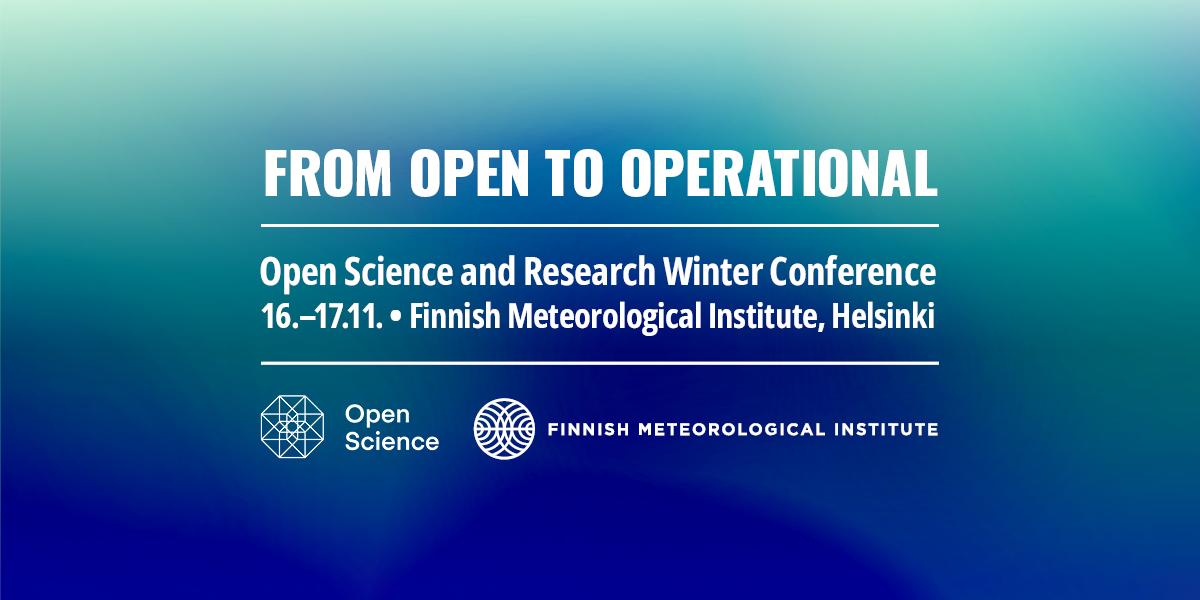
The Open Science and Research Winter Conference will take place on 16–17 November 2026 at the Finnish Meteorological Institute in Helsinki. The event is organised by the Finnish Meteorological Institute and the Open Science and Research Coordination. The theme of the 2026 Winter Days is “From Open to Operational.” The event will be held in a hybrid format. The Languages of the event will be English and Finnish.
Open science has moved beyond principles and policies. The challenge today is no longer whether science should be open, but how openness can be transformed into real scientific, societal and economic impact. This year’s winter conference explores how to bridge the gap between vision and implementation, turning open science into an operational reality.
The event consists of keynote presentations and thematic sessions, where short presentations are combined with interactive discussion between the audience and the speakers. Thematic sessions will include researchers views to what are the bottlenecks of open science, exploring the promises of AI to research and interoperable open science ecosystems and processes, not forgetting the northern lights.
Program
Maanantai 16.11.2026
From Principles to Practice
10:30–12:00 Opening Words & Keynote
- Opening and Welcome, Henriikka Mustajoki, Secretary General, Federation of Finnish Learned Societies, Jari Liski, Director of Climate Research Programme, Finnish Meteorological Institute
- Keynote, Klaas Wierenga, Chief Services Officer, GÉANT, the Association of European Research & Education Networks
12:00–13:30 Lunch
13:30–15:00 What Researchers Actually Need (looking for bottlenecks)
Researchers are often at the center of Open Science discussions but rarely at the center of open science decision-making. This session gives the floor to researchers from different disciplines to discuss the practical barriers that slow down research and the support mechanisms that would make the greatest difference.
- Harri Kokkola, Research Professor, Finnish Meteorological Institute
- Maxime Grandin, Researcher, Finnish Meteorological Institute
- Veikko Ikonen, Manager, Technical Research Centre of Finland (VTT)
- Salla-Maaria Laaksonen, Reseacher, University of Helsinki
Session host: Anca Hienola, Leading Specialist, Finnish Meteorological Institute
15:00–15:30 Coffee Break
15:30–16:45 AI Will Not Save Bad Research Infrastructure
Artificial intelligence promises to transform research, but AI systems are only as effective as the data, metadata and knowledge structures that underpin them. This session explores the foundations required for trustworthy and reproducible AI-enabled science.
- Anna Lindfors, Product owner, CSC (LUMI AI Factory)
- Reija Haapanen, Chair, Responsible AI association; Executive Manager, Finnish Society of Forest Science,
- Ossi Nokelainen, Researcher, University of Jyväskylä
- Anu Helkkula, Senior Research Specialist, Hanken School of Economics
Session host: Jonni Karlsson, Senior Specialist, Federation of Finnish Learned Societies
16:45 End of program
Tuesday 17.11.2026
Developing an Operational Open Science Ecosystem
09:00–10:15 When Policies Make a Difference for Openness
Open science has generated numerous policies, frameworks and requirements. Which of these genuinely help researchers, and make a difference for openness? This thought-provoking discussion will challenge assumptions and encourage critical reflection on current practices.
- Susanna Nykyri, Chief Specialist, University of Tampere
- Pekka Uotila, Manager, South-Eastern Finland University of Applied Sciences XAMK
- Erika Lilja, Head of Group, Senior Specialist, Finnish Environmental Institute SYKE
- Liisa Kulmala, Researcher, Finnish Meteorological Institute
Session host: Sami Niinimäki, Senior Ministerial Adviser, Ministry of Education and Culture
10:15–10:45 Coffee
10:45–12:00 National Open Science Coordination: Awards and News
This session highlights national Open Science achievements, presents Open Science awards and provides updates on key national initiatives and coordination activities
- Presenting the 2026 Open Science Awards
- TBA
- TBA
12:00–13:00 Lunch
13:00–13:45 Keynote
- Riina Vuorento, Senior Ministerial Adviser, Ministry of Education and Culture
13:45–14:15 Coffee
14:15–15:30 Building an Infrastructure That Researchers Will Actually Use
Researchers do not experience open science as separate policies, infrastructures and services. They experience it as a workflow. This session explores how the various components of the open science landscape can work together to create a coherent researcher experience.
- Jessica Parland-von Essen, Development Manager, CSC (EOSC node)
- Emma Bruus, Technical Architect of the Skywarden Platform, Finnish Astronomical Association Ursa
- Tomi Rosti, Information Specialist, University of Eastern Finland
- Marko Peura, Secretary General (research infrastructures), Research Council of Finland
15:30–15:45 Closing words
15:45 End of Program
Wednesday 18.11.2026
09:00–12:00 Remote morning for National Expert Panels
Photo: TSV


