The results of Open Science and Research Monitoring 2026 have been published. Most participating organisations improved on their Monitoring 2024 results.
In 2026, open science and research monitoring was carried out for the last time using the 2022 monitoring model. The leading idea in this implementation was to enable all research organisations to ascertain how far their progress had gone under the current set of indicators.
Monitoring aims to support organisations in developing open science and research, support and verify the achievement of the objectives agreed in the Declaration for Open Science and Research and the policies, and form an overall view of the state of open science and research in Finland.
Many respondents achieved the highest result
Fourteen research organisations achieved the highest possible openness result, 5/5, for the first time in Monitoring 2026. This means degree 5 in all areas of openness (culture for open scholarship, publishing, data and education) and an overall openness level of 5 calculated from these degrees. Including those that achieved a 5/5 result in Monitoring 2024, a total of 22 research organisations have reached this result.
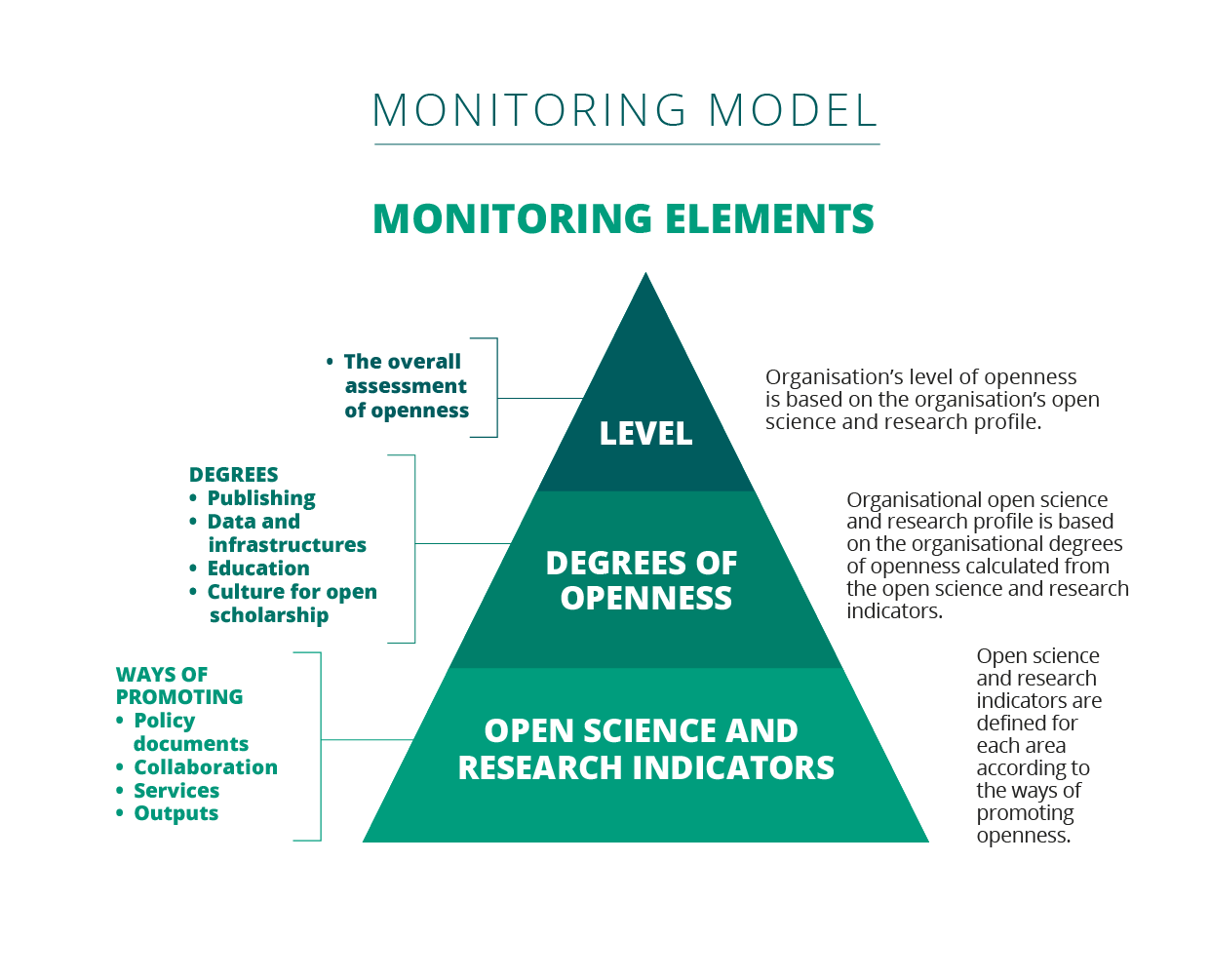
Learn how degrees and levels are defined:
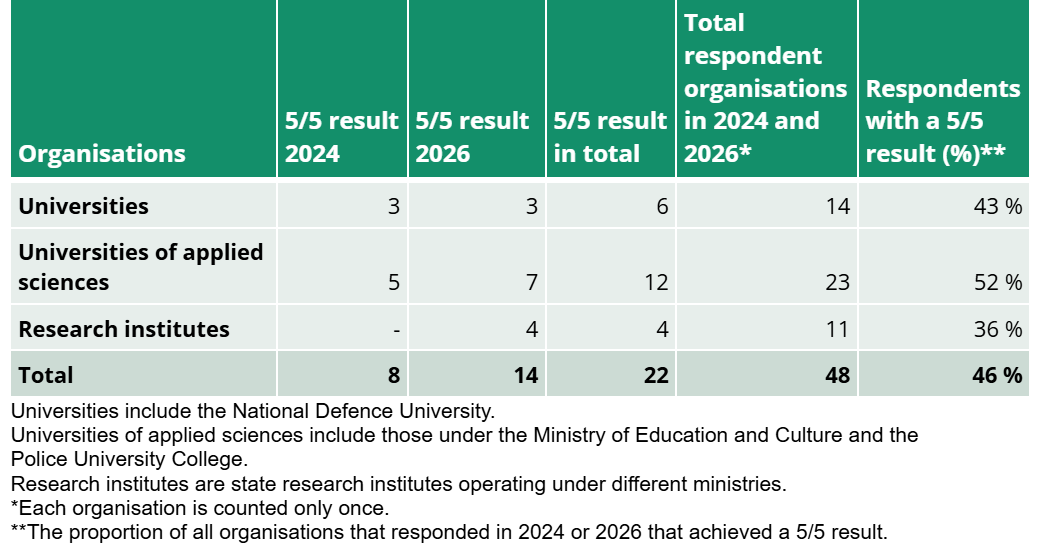
Universities of applied sciences made strong progress. More than 90% of universities of applied sciences that still had room to improve increased their degree of openness in at least one area. Three universities of applied sciences that responded to the full survey and four that responded to questions in a single area achieved the highest result, 5/5. With five universities of applied sciences having already reached this level in 2024, a total of 12 (52%) have achieved the highest level, 5/5, in open science and research monitoring.
This year, the first research institutes reached the highest possible openness level, 5/5, as two institutes that responded to the full survey and two that responded to questions in a single area progressed to this level. In addition, all but one research institute improved their results in at least one area.
Three universities achieved a 5/5 result in 2026: one that responded to the full survey and two that responded to questions in a single area. In addition, one university that responded to the full survey and one that responded to questions in a single area improved their openness level. Three universities achieved a 5/5 result in 2024. This brings the total number of universities that have achieved the highest result in open science and research monitoring to six (43%).
Guiding documents largely unchanged, strong progress in services
Changes in the results for guiding documents were mostly small. Guidance on responsible assessment and citizen science were the most notable exceptions with clear progress from 2024. However, fewer organisations had documents guiding openness in education than in the 2024 survey.
For the first time, every area of openness includes services provided by all respondents. Progress is particularly strong in research data. All organisations provide data management support both for researchers and research, development and innovation (RDI) staff and for students and doctoral researchers, as well as basic data protection support for research data management.
Some of the advanced services for responsible assessment remain among the least commonly available, as do services supporting opening research methods, which were included in the survey for the first time. These services were offered by fewer than one in four organisations. However, the least common service is the automated updating of metadata to the Library of Open Educational Resources. Only one organisation provides this service.
Specific features of Monitoring 2026
Participation in Monitoring 2026 differs from previous years. Only organisations that had remained below degree 5 in one or more areas of openness in 2024 were invited to participate in open science and research monitoring. Organisations that had remained below degree 5 in a single area answered only the questions for that area. Other organisations answered all questions. When comparing monitoring results across years, it is important to bear in mind the change in respondent numbers compared with previous implementations.
All universities of applied sciences under the Ministry of Education and Culture and the Police University College responded to the monitoring survey, as in previous years. However, two fewer universities and two fewer research institutes participated than in 2024. In terms of researcher numbers, the research institutes that did not respond are small, while the universities are large. The participation of Social Insurance Institution of Finland Kela’s research unit also brought an entirely new respondent and respondent type into the monitoring.
The response rates in 2026 were as follows, with the 2024 rates in brackets:
- universities of applied sciences 100% (100%)
- universities 84% (93%)
- state research institutes 75% (92%)
Text: National Open Science Secretariat
Picture: Federation of Finnish Learned Societies
You might also be interested in